Roles
Technical Role - Participant
As established in the chapter on Layers the only technical role is the Participant. In this Rulebook, a Participant denotes the technical role that represents a legal organisation (not a natural person) and is capable of operating the required software agents; where an individual acts, they do so as a legal entity or via an organisation that represents them. However, there are many different roles possible in the economic and legislative layers of a data space. This chapter explains the most important ones.
Data Space Governance Authority
The Data Space Governance Authority (DSGA) is a special, functional role within a data space. It can be understood as the "legislative" of the data space by having the functional responsibility to define the rules and processes of the data space.
It serves a logical purpose within the Data Space Governance Framework but has no single definition of how it is implemented. To fully explain the role of the DSGA and not to distract from the Participant roles it is described in detail in its own chapter: Data Space Governance Authority(DSGA)
Common Business Roles
Business roles in this Rulebook describe functions, and no status. The model definition of roles should provide clarity about tasks and capabilities and support the understanding of architectures and processes. Roles may not always exist in their pure form - mixed forms are often experienced by participants in data spaces - and new or more specific roles will emerge over time. In this section we define the most important and common roles without claiming to be exhaustive. In practice, it has proven useful to first implement the essential roles that are necessary for the data space to function. Three roles should be established first: data provider, data consumer, and intermediary services.
Data consumer
Data consumers are the recepients of a data sharing activity. In the IDSA Rulebook the data consumer is the party acting as the consumer of a data sharing contract.
The closely related term "data user" describes a natural or legal person who has lawful access to certain personal or non-personal data, and has the right to use that data for commercial or non-commercial purposes.
The data user and data consumer can be separate organisations but often will be two perspectives on the roles of the same participant, depending on the context.
Data provider
Data providers are the organisations that make data technically available for a data sharing activity. In the IDSA Rulebook the data provider is the party acting as the provider of a data sharing contract.
The closely related term "data holder" describes a natural or legal person, who is not a data subject with respect to the specific data in question, who has the right to grant access to or to share certain data in accordance with applicable law.
The data holder and data provider can be separate organisations (e.g. in cases where intermediares are being introduced) but often will be two perspectives on the roles of the same participant, depending on context.
Role mapping guidance:
- Data Holder: the legal owner or rights holder of the data (responsible for legal compliance and consent decisions).
- Data Provider: the entity that makes the data technically available (responsible for data access, availability, and technical controls).
- When roles differ: Contracts must explicitly allocate responsibilities (consent, liability, enforcement, and notification) and the DSGA may require that member self-descriptions include role assignments to make responsibilities discoverable.
Service Provider (intermediary, value-adding services)
In a data space optional service providers can offer optional capabilities to enable data sharing or to provide business services. Fundamentally, all such service providers are considered to be a participant in a data space and therefore bound to the agreed policies and rules of a given data space. Their implementation must be representable as a participant at the technical level.
Intermediaries are services that are acting on behalf of participants in the data space. This can be a range of activities within the data space: negotiating a data sharing contract on behalf of a participant, implementing technical infrastructure on behalf of the participant and making decisions on behalf of a participant, thus impacting their digital sovereignty.
Such intermediaries may be regulated by local governments like the EU Data Governance Act in the European Union, which defines a specific "Data Intermediary" role. A detailed analysis can be found in the paper Reflections on the DGA and Data Intermediaries.
Intermediary usage guidance:
- Optional: Intermediaries may be used voluntarily by participants to simplify operations or reduce cost. When optional, their use is a matter of participant choice and does not reduce the baseline autonomy provided by the data space.
- Mandatory (Regulatory): If law or regulation requires an intermediary role, the DSGA must explicitly document this requirement and provide safeguards (e.g., audit rights, transparent processes, alternative providers where feasible) to limit negative impacts on participant autonomy.
- Impact mitigation: Where intermediaries are required or offer substantial control over interactions, the DSGA should require explicit documentation of the scope of delegated authority, revocation mechanisms, and participant redress processes.
Value-added service providers act as participants in the data space and therefore conform to the data space governance framework. Such services support value creation with a broad set of discovery, processing, and governance capabilities. Common examples and their expected functions include:
-
Data Discovery Services (catalogs, search engines, registries): Provide standardised metadata, search interfaces, and registry functions that allow participants to locate datasets and service offerings. These services should provide interoperable metadata schemas, and support attribute-based-access-control visibility rules.
-
Lookup Services (vocabularies, shared information): Maintain authoritative semantic resources such as controlled vocabularies, ontologies, and code lists that ensure consistent interpretation of attributes and data elements across participants. Lookup services should be versioned, discoverable, and accompanied by governance information describing scope and maintenance procedures.
-
Observability Services (audit, notary): Offer verifiable logging, attestation, and auditing capabilities that help detect misuse, support dispute resolution, and provide forensic evidence. Observability services must balance provenance and transparency with privacy and minimisation principles.
-
Commercial Services (marketplaces, auctions, match-making): Facilitate commercial discovery, negotiation, and transaction orchestration for data products and value-added services while operating within the governance and policy constraints of the data space. These services must not introduce mandatory central controls unless such centralization is explicitly justified and documented by the DSGA.
Potential roles from legal defintions
Roles might also be described by legal regulation. An example of such regulation that defines roles in data sharing are the European Union regulations, like GDPR or DGA:
- Data Rights Holders are natural or legal persons, holding rights on the data.
- Data Recipients are legal or natural persons that act as data consumers and data users.
- Data Users are natural or legal persons, which use the data under the given policies and regulations.
- Data Subjects are defined in GDPR.
- Data Intermediation services or Data Intermediaries are subject of the Data Governance Act. (see Reflections on the DGA and Data Intermediaries)
Summary
In line with the description of the role models and the layered approach, the diagram below presents an overview on roles in data spaces and their affilation to the layers.
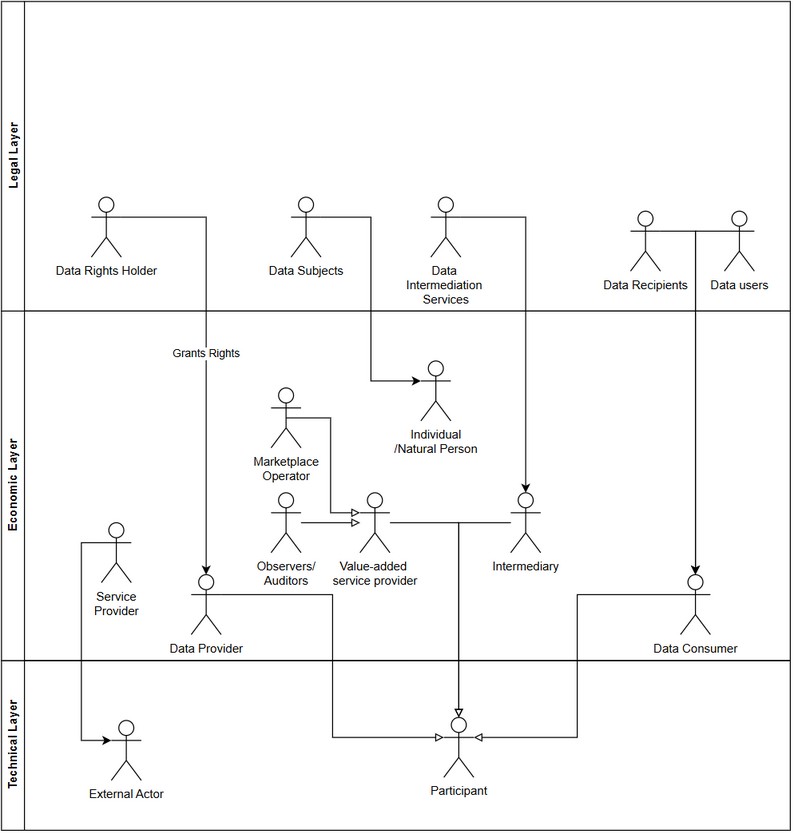
This diagram is a foundation to depict the typical use cases of the roles in relation to data spaces.