Vocabularies
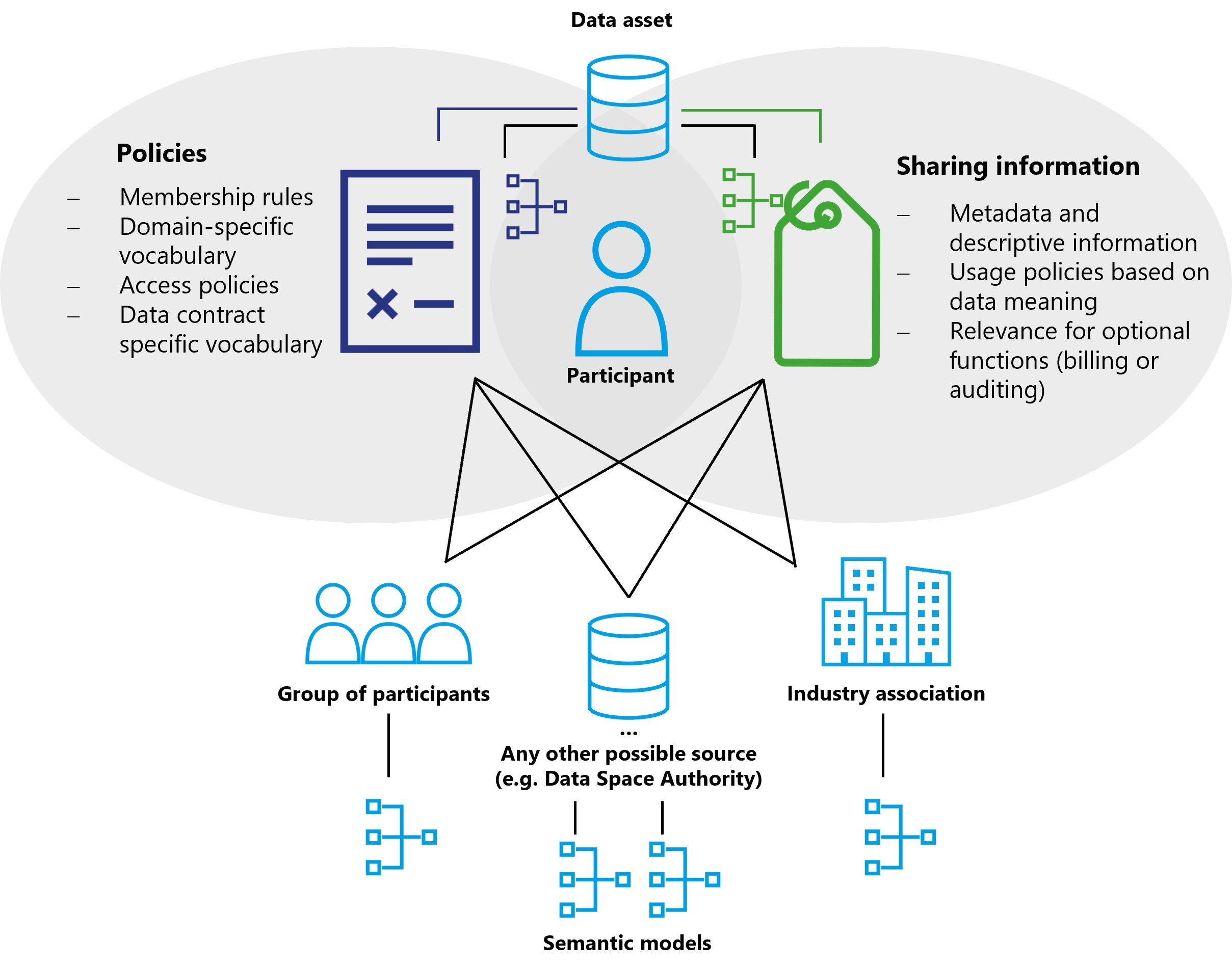
Vocabularies are used to ensure that everyone means the same thing when using a specific term. There are multiple vocabularies that may be used in a data space, but two are particularly noteworthy:
-
Semantic models for policies: Structured models that define the terms, attribute names, and allowed values used in policy expressions; these models make policy requirements machine-interpretable and reduce ambiguity during reconciliation.
-
Semantic models of the shared data assets: Domain-specific data models and ontologies that define the meaning and structure of shared datasets, enabling consumers to interpret and process data correctly and to enforce usage policies based on data semantics.
So far, this document mostly described how a data space works, what contracts are, what types of policies exist, and how to negotiate a contract. The vocabularies describe the content of these elements.
The first category is the vocabulary of policies, which can exist on multiple levels:
-
Semantic model for policies for membership rules\ For example, if a data space wants to restrict membership to companies with a HQ in certain countries. It must be clear what the policy is called and what values are allowed.
-
Policies that each member of the data space must understand to interact with other participants. For example, policies that specify which industry vocabularies must be understood, and access policies.
-
A participant can publish additional information on semantic models relevant for the interaction with this participant. This could be special access policies under which this participant publishes additional contracts. It could be an access policy that specifies access for direct suppliers of this participant.
-
Within the Data contract as a machine-readable specification that describes the contractual terms, associated policy constraints, and the semantic models required to interpret the asset. The data model, vocabulary, or usage rules that must be understood to correctly interpret and enforce contract-specific policies (for example, an industry-specific usage restriction expressed as a domain ontology).
The vocabularies for each level can be easily referenced by the metadata publishing mechanism at the respective level. A data space can reference the required policy vocabulary through its self-description. A participant can also leverage its self-description to publish additional vocabulary requirements. And at the data contract level, this information can be easily stored in the metadata associated with the contract at the catalog level.
For mandatory vocabularies a policy referencing them can be easily established if such a policy model has been agreed upon.
Semantic models for data assets work on the same principle with the main difference that they do not describe functionality of the data space itself, but the meaning of the data being shared. If this data needs to be understood to properly handle usage policies (e.g., if usage policies are based on the meaning of data) it becomes an essential part to be considered in the design of the data space. Semantic data models might also be relevant for optional functions such as billing and auditing.
How best to manage the publication of vocabularies depends on the design of the data space and its requirements. There can be central servers hosting the semantic models, public semantic models from industry associations that can be referenced externally, a group of participants responsible for publishing and synchronizing common semantic models, or semantic models that each participant receives when joining the data space and which can be continuously updated through various synchronization mechanisms.
Optional functions
In addition to the functional elements of a data space, many optional roles and components exist. The entities providing these functions must join the data space like any other participant and fulfil all requirements, policies and procedures enforced by the DSGA to establish trust.
Depending on the services provided, these additional elements may need to issue additional credentials, introduce additional trust anchors, or require specific data contracts. There is a wide variety of optional roles and services. Some especially useful ones are described here.
In general such optional functions can be distinguished as intermediary functions or value-creating functions. Intermediaries can participate in data spaces as value-creating services or functions.
Intermediaries are considered as optional in data spaces. Due to certain regulations like the Data Governance Act, such intermediaries may require additional governance.
Value-adding services may be realized by intermediaries or as function of a data space participant. Such value-adding services are not subject to the IDSA Rulebook, but are explained in the DSSC Blueprint Version 3.0 in more detail. The IDSA Rulebook provides a limited explanation below.