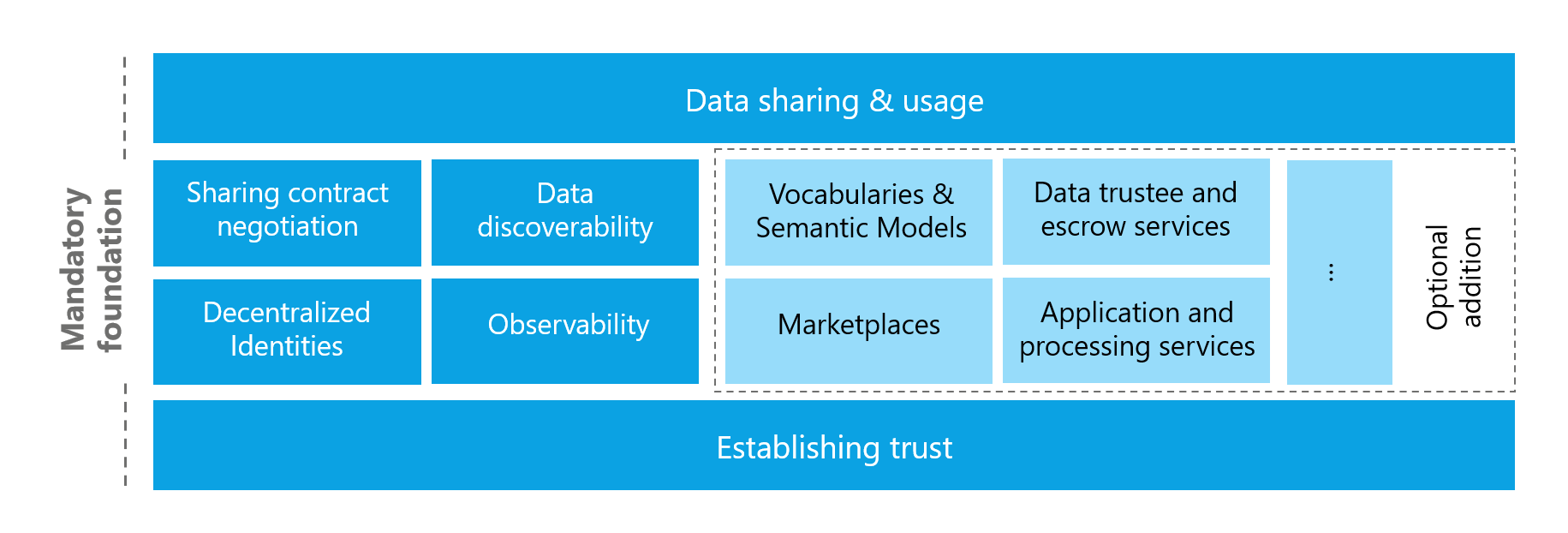
Foundational concepts of a data space
The mandatory foundational concepts and functional areas of a data space are:
-
Establishing trust: Defining the procedures, evidence categories, and decision rules that enable participants to evaluate the suitability of counterparties.
-
Data sharing and usage: Specifying the permitted data flows, processing activities, and contractual obligations that govern how data may be used after it is shared.
-
Data discoverability: Providing metadata and discovery mechanisms that enable participants to find and assess available data assets and services.
-
Sharing contract negotiation: Establishing the processes and protocols—ranging from automated negotiation to manual escalation—used to reach mutually acceptable contract terms and policy alignments.
-
Decentralized identity capabilities: Ensuring participants can represent identity and attributes in a verifiable and privacy-preserving manner; DIDs and verifiable credentials are the recommended approach, while functionally equivalent implementations may be acceptable if they preserve participant autonomy and interoperability.
-
Observability: Ensuring auditability and runtime monitoring capabilities to detect violations, gather evidence for disputes, and support continuous trust evaluation.
Additional value-adding services that support these main functions of a data space may include the following optional functional areas:
-
Vocabularies and semantic models: Curated ontologies and schema registries that improve interoperability and precise meaning of data shared across participants.
-
Application and processing services: Hosted or on-demand processing capabilities (for example, analytics, enrichment pipelines, or confined compute) that offer contract negotiations for API endpoints and enforceable usage policies.
-
Marketplaces: Commercial catalogues and negotiation platforms that facilitate discovery, pricing, and contractual arrangements for data products and services while respecting governance and access policies.
-
Data trustees and escrow services: Neutral service providers that hold, mediate, or process data under predefined governance constraints (for example, confined compute or escrowed storage) to enable joint analysis while preserving confidentiality.
-
Other optional value-added services: Additional capabilities such as notary, or auditing services, and specialised domain-specific tooling which may be selected to meet particular participant requirements.
-
Semantic Models: Semantic models are listed as optional because their required depth and degree of harmonisation are context-dependent and should be determined by the DSGA and participant needs. In many data spaces, a shared core vocabulary will still be practically necessary for interoperability, even where complete domain harmonisation is not mandated.